
Why enterprise AI needs a model portfolio

The question is not which model performs best, but which model is proportionate to the task in front of it.
Many enterprise AI workloads are narrower than the models used to run them. Classification, extraction, retrieval, summarization, and other repeatable tasks may not require the open-ended reasoning capabilities of a frontier model.
The mismatch often begins during the pilot. Teams reach for a highly capable model to establish whether the use case works. The pilot succeeds, the model choice remains, and volume arrives later. What looked inexpensive at pilot scale can become a significant recurring cost in production.
Small language models generally use fewer parameters and are designed for more constrained compute and deployment environments. Some are trained at smaller scale from the outset, while others may benefit from techniques such as knowledge distillation or pruning. Quantization can further reduce memory and compute requirements, making compact models easier to deploy on constrained hardware.
No fixed parameter count separates small from large, and the boundary moves as hardware improves. The design goal is stable even when the definition is not. These models exist to run where a full-scale model would be too slow, too expensive, or too large to fit.
A larger model holds more parameters and tends to handle multi-step reasoning better. That matters for some workloads and hardly at all for others, and the distinction is what most model selection gets wrong.
Consider a support system that reads incoming support tickets and routes each one to the appropriate queue at high volume. Sorting tickets into queues, pulling fields off a form, recognizing entity names, or summarizing a short document requires little open-ended reasoning. What it requires is accuracy that holds across a very large number of runs. That is a different requirement, and not necessarily an easier one.
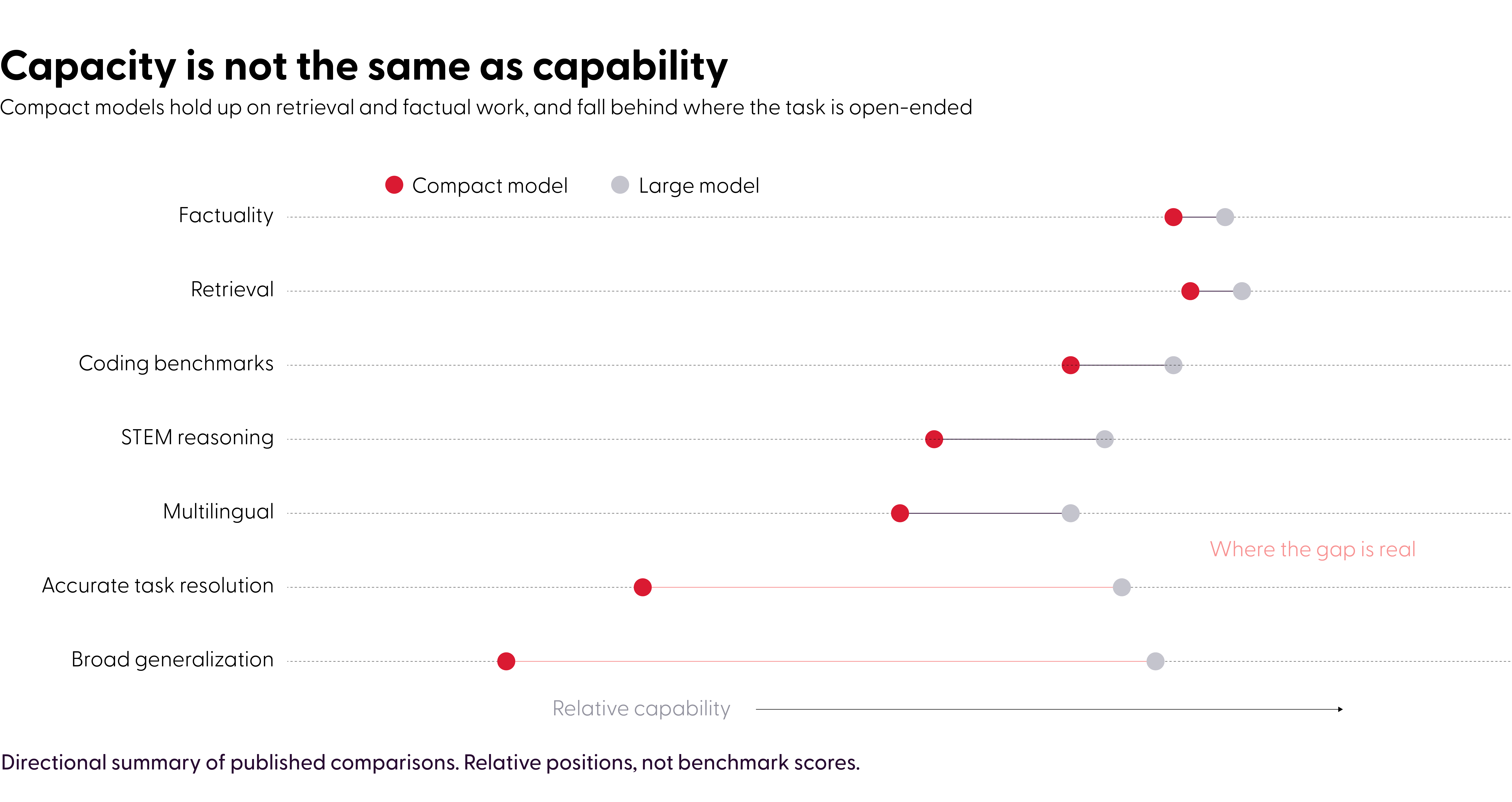
Published benchmark comparisons support the narrow version of this argument. Compact models perform competitively on factuality, retrieval, and coding benchmarks, and hold up reasonably in STEM and multilingual evaluations. Task-resolution accuracy and broad generalization remain the weaker areas. Both halves matter, and anyone adopting a small model as a straight replacement is addressing only the first.
The shift happens wherever data movement is the constraint. Running inference locally keeps user data on the device, removes round-trip latency, and eliminates both the recurring API cost and the dependency on connectivity. For mobile applications, automotive systems, wearables, and clinical devices in facilities with unreliable networks, that combination is often a precondition rather than an optimization.
Quantization is one of the techniques that makes local deployment more practical. Four-bit quantization and distillation from larger teacher models can support deployment on mobile and edge hardware while retaining much of the core capability in text understanding and retrieval. The cost is that on-device inference must be optimized for the specific hardware it runs on, work that a cloud API absorbs on the customer’s behalf. We examine the infrastructure side of that cost in The hidden cost of AI: Why sustainable infrastructure is the next strategic battleground. Model selection sits upstream of it, because the choice made during the pilot determines how much of that cost is ever incurred.
For regulated industries, model selection also becomes a data-governance decision. Self-hosted and open-weight models can give organizations greater control over where sensitive data is processed, how models are configured, and how deployment environments are governed.
That can make smaller or self-hosted models attractive for workloads where data residency, privacy, latency, or infrastructure control outweigh access to frontier-model capability.
A practical enterprise model portfolio may combine several deployment patterns. Self-hosted models can serve workloads requiring greater control over data and infrastructure. Smaller task-specific models can handle high-volume, repeatable work. Hosted models can provide flexibility across variable workloads, while frontier models can be reserved for tasks where advanced reasoning or multimodal capability materially improves the outcome.
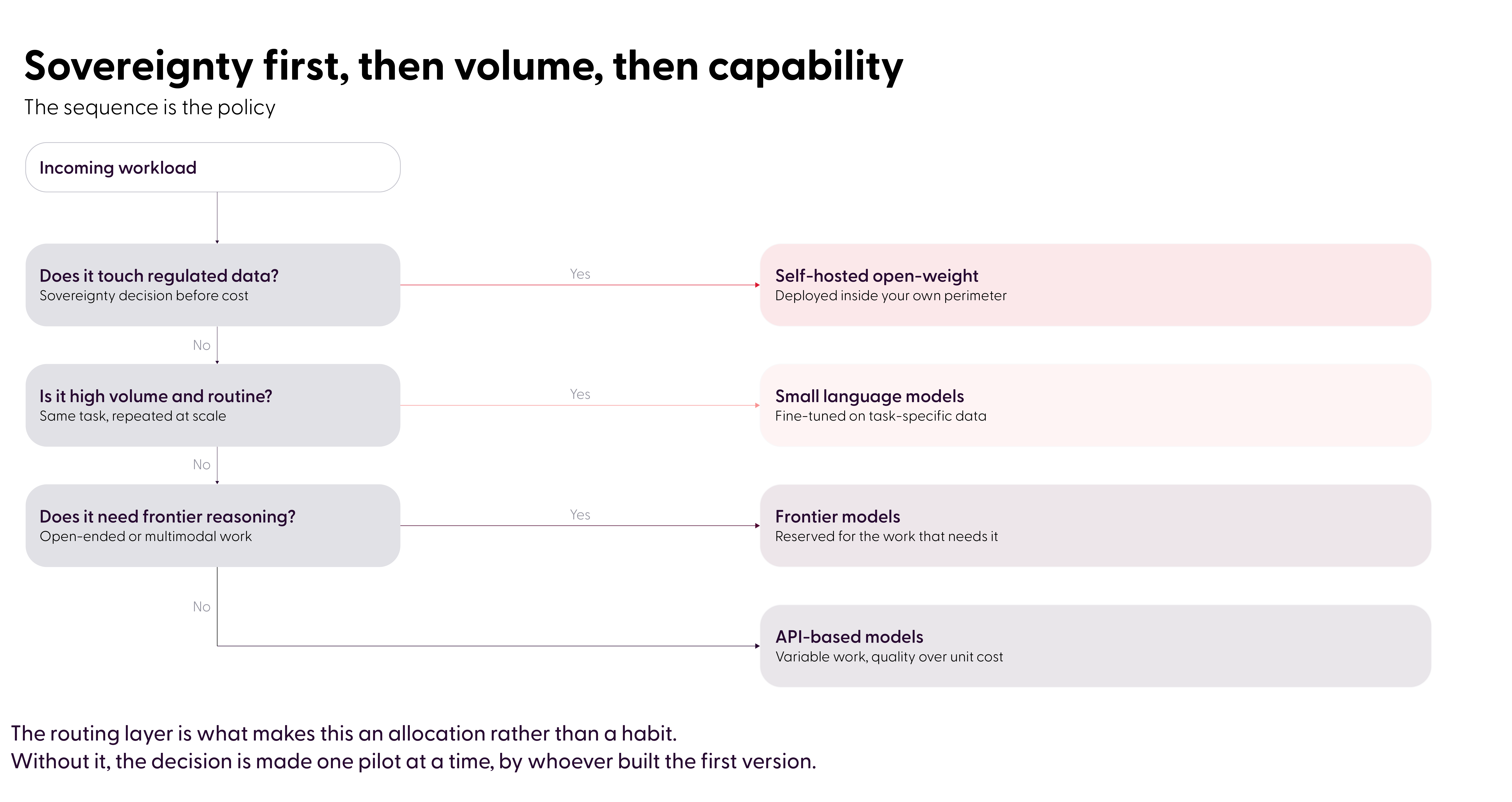
What makes this work is a routing layer and an explicit policy about which category a workload belongs to. What makes it fail is letting that decision be made implicitly, one pilot at a time, by whoever built the first version. The difficult part of model selection is rarely identifying the strongest model but building the evaluation and routing discipline that makes a smaller or more specialized model safe to use wherever it is sufficient.
A smaller model fine-tuned on high-quality domain data can, for some narrow tasks, match or outperform a larger general-purpose model while requiring fewer resources. That is the mechanism behind many successful deployments: a smaller model doing one job properly. It also means an organization with clean, well-governed data in its own domain can build something a competitor cannot buy. In task-specific AI, proprietary domain data can become as important a differentiator as model choice.
Fine-tuning creates a standing obligation as well. A tuned model must be re-evaluated whenever the upstream data, the task definition, or the base model changes.
Two failure modes recur here, and both are measurement problems rather than problems with the model itself.
The first is contamination, since models trained on web-scale corpora may have encountered the evaluation data during pre-training, which inflates scores and obscures how the model performs on work it has not seen. That makes published comparisons less reliable than they appear, and evaluation against representative held-out enterprise data provides a more meaningful production check.
The second is context. Models do not use the full context window they advertise with uniform reliability, and information placed in the middle of a long input is more likely to be missed, an effect commonly described as lost-in-the-middle. Designing a pipeline on the assumption that the model reads everything it is sent creates a failure mode that stays invisible until it matters.
What separates deployments that hold from those that stall is rarely the model selection. It is whether evaluation, routing, and monitoring were designed beforehand, and model selection is the input most often settled before anyone has defined how the result will be measured.
The question worth putting to any AI workload is not which model performs best in general, but what this particular task requires, how often it runs, where its data is allowed to travel, and what a single failure costs. Those four answers eliminate most of the options quickly, and in most cases eliminate more than the enterprise expects.
None of this argues for smaller models everywhere. Some workloads do need frontier reasoning, and under-spending on those is the more expensive mistake. The argument is only that the decision should be made deliberately rather than inherited from whichever pilot ran first.
The more difficult part is that someone has to be responsible for asking. Model choice sits in an awkward place, too technical for the people who own the budget and too commercial for the people who own the pipeline, which is how it ends up settled by default rather than by anyone. For enterprises running AI at volume, proportion is a governance decision before it is a technical one. The ones that handle it well review model allocation the way they review any other recurring cost, on a schedule, with a named owner.
The goal is not to run every workload on the smallest model possible. It is to stop paying for capability the workload does not need while preserving the capability it does.
In enterprise AI, the best model is not the most powerful one. It is the one proportionate to the task.
