
When autonomous finance outruns control

Once a system can post to the ledger on its own, the question shifts from what it can automate to what the enterprise can prove it did.
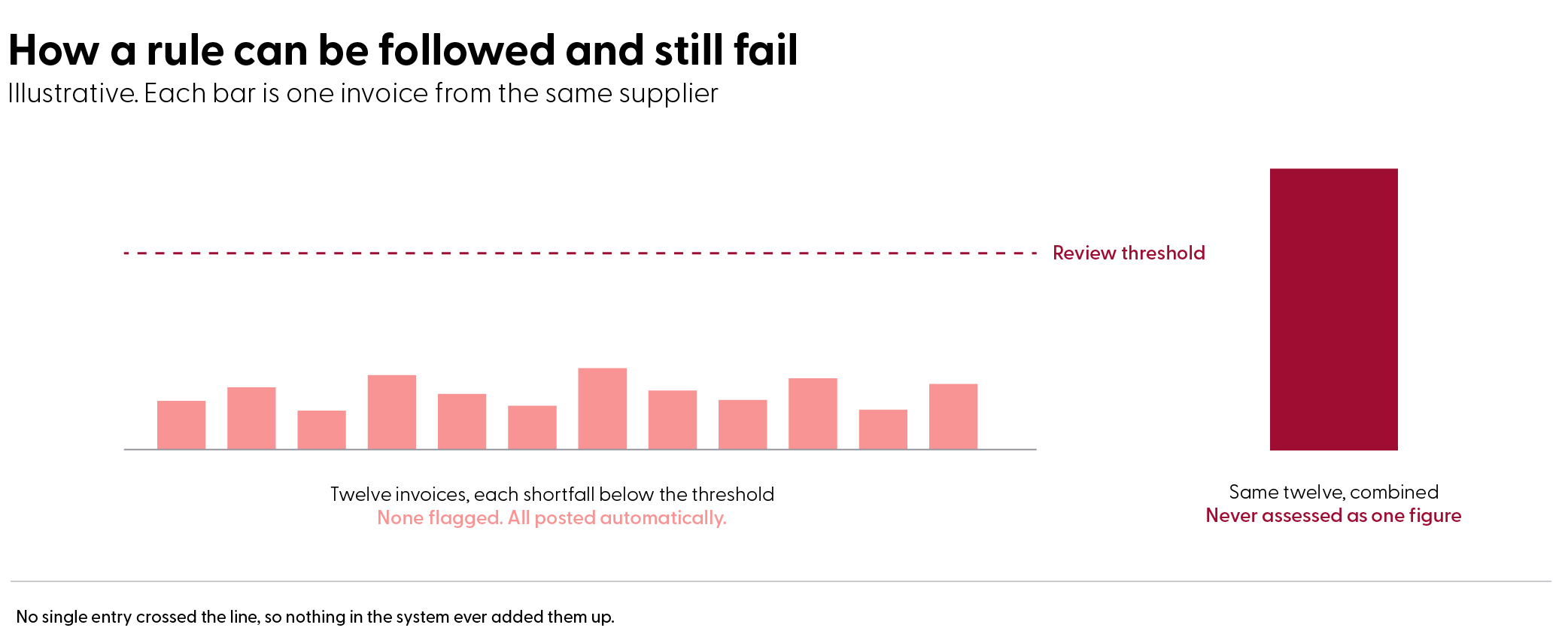
Most finance teams have a tolerance rule somewhere. Below a certain size, a shortfall in a delivery is absorbed rather than queried, because chasing every small gap costs more than the gaps are worth. The trade-off is reasonable, and in most cases it holds.
The problem begins when one supplier comes up short on order after order, each time by an amount small enough that the rule waves it through. Nothing looks wrong. Every entry was posted correctly, under a rule the team approved itself. No exception is raised, so no one has reason to look.
That is the shape of the problem in autonomous finance. The software is not malfunctioning. It is doing exactly what it was told, far faster than anyone can review, while the reasoning behind the instruction stops being questioned.
Traditional ERP was primarily designed to record transactions, enforce predefined business rules and orchestrate structured workflows. Decision logic was largely deterministic and configured in advance. Emerging AI-native architectures introduce a different layer: systems that can interpret context, reason across information and initiate actions within defined controls.
In emerging AI-native ERP architectures, intelligence can sit directly within transactional workflows, allowing systems to interpret context and initiate actions rather than simply record decisions made elsewhere. A system may, for example, use current financial data to initiate an entry or adjust an accrual based on predefined rules and controls. At that point, the system is no longer only recording a decision. It is participating in the decision-making process.
The opportunity is significant. Exception handling, document processing, reconciliation, and data handoffs create substantial manual effort across back-office finance operations. Increasingly intelligent automation can reduce that intervention, particularly in structured, repeatable workflows.
Those numbers describe output, not control. A touchless rate measures how much work passed through without a person. It says nothing about whether the work was correct, permitted, or explainable afterwards.
Once a system can act on its own, the question is no longer whether it can do the work, but whether anyone can show why it did. The usual failure here is governance drift, which is the gradual accumulation of small automations that no one formally approved or tracks. Each looks harmless in isolation, but together they can leave a control environment that an auditor cannot reasonably reconstruct.
A stronger approach is to build these limits into the system rather than rely on policy documents alone. One pattern is to constrain the set of queries or actions an agent may execute at configuration time, allowing it to reason over approved information without independently expanding its access.
The same thinking appears as posting gates, role-based access, rules expressed as code so that they enforce themselves, and audit trails in which every automated step records why it fired.
The aim is not to slow automation down. It is to capture the evidence behind an action as it happens rather than reconstruct it under pressure months later. We explore that argument in reimagining compliance in the age of digital transformation. IIn autonomous finance, the stronger design principle is to capture that evidence at the moment of action rather than reconstruct it during a later review.
Depending on jurisdiction and reporting obligations, retention requirements for that evidence may extend well beyond the life of the system that produced it.
Errors do not all carry the same consequence. A miscoded office-supply invoice may create a relatively small operational issue. An incorrect amount on a large payment or a missed compliance requirement can carry significantly greater financial or regulatory consequences.
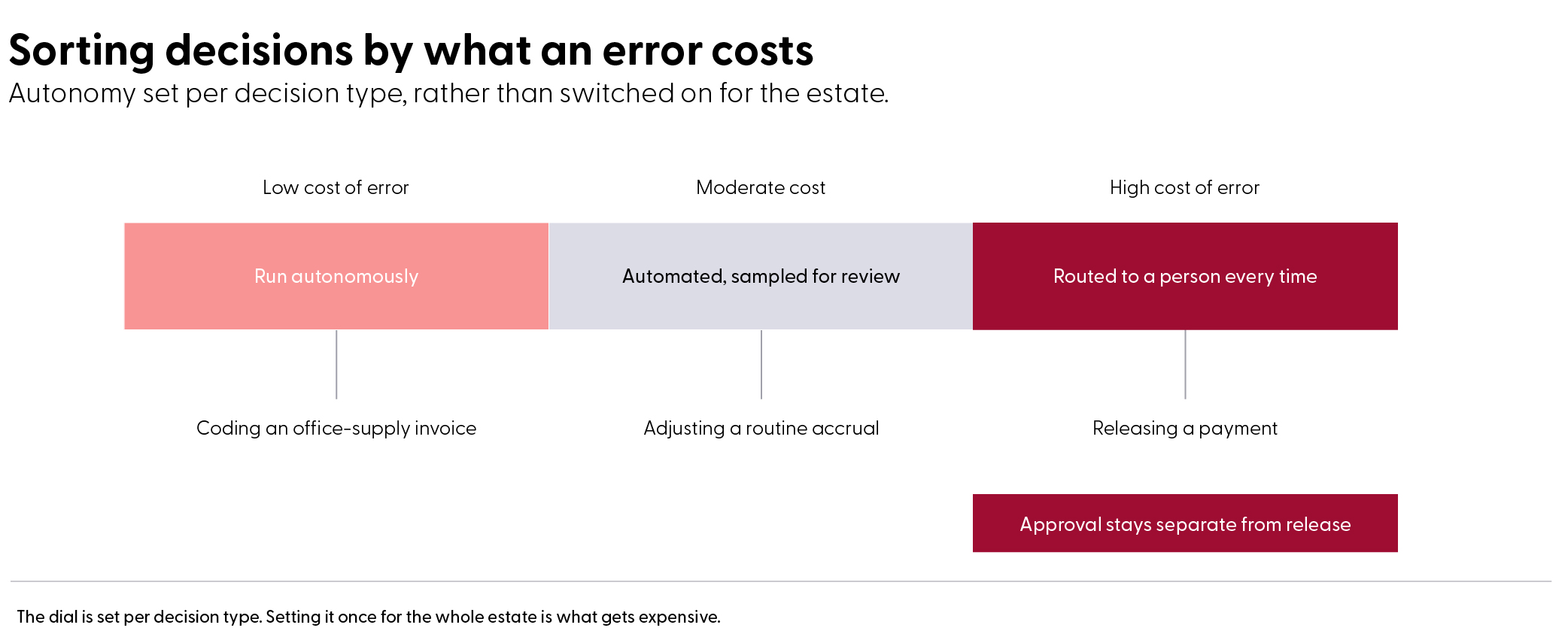
A workable design grades decisions by consequence and applies stronger controls as the potential impact increases. Payment release is a clear example. Approval authority should remain appropriately separated from payment execution, regardless of how capable the automation becomes. Controls such as segregation of duties and three-way matching remain relevant in an autonomous back office. They are part of what makes autonomy safe to grant.
A successful pilot demonstrates that the technology can perform the task. Production introduces a broader set of requirements.
Inconsistent master data, differences in how the chart of accounts is interpreted across entities, unclear decision ownership, approval hierarchies, segregation of duties, and audit requirements can all become barriers to scaling autonomous finance. These are not simply implementation details. They determine whether an automated decision can be trusted and defended once it enters a production financial environment.
Moving into production therefore requires more than data and system integration. It also requires mapping the chart of accounts, establishing approval hierarchies and segregation of duties, defining ownership, and ensuring that the resulting control environment can withstand audit scrutiny. We examine that shift from process automation to integrated intelligence in from RPA to intelligent automation. In an AI-native ERP, however, the integration work extends into the control environment itself.
Getting a model to post an entry correctly is only part of the challenge. Enterprises also need the data foundation, ownership model, and control environment that make the posting defensible later.
Let us come back to that supplier and the shortfalls nobody ever caught. Every entry there was posted correctly, under a rule finance had written itself, which is exactly why nothing flagged it and why the pattern survived as long as it did.
That suggests a better measure of autonomous finance maturity than automation rate alone: can the organization retrieve an entry months later and show what rule fired, what data informed it, who or what was responsible for the action, and why the outcome was considered valid?
An organization that can do that has earned the autonomy it granted. One that cannot has simply moved the work somewhere it will be more difficult to find.
For finance leaders moving from pilot to production, the critical question is no longer whether the system can post the entry without a person. It is whether the organization can reconstruct, months later, why it did, and defend that reasoning to an auditor. Autonomy is ultimately an evidence capability.
As AI capabilities become embedded more deeply into ERP platforms, the control architecture around them still has to be deliberately designed. Enterprises must decide what the system may do before it acts and preserve the evidence needed to explain those actions afterwards.
In autonomous finance, control cannot begin at the audit. It has to begin with the decision.
